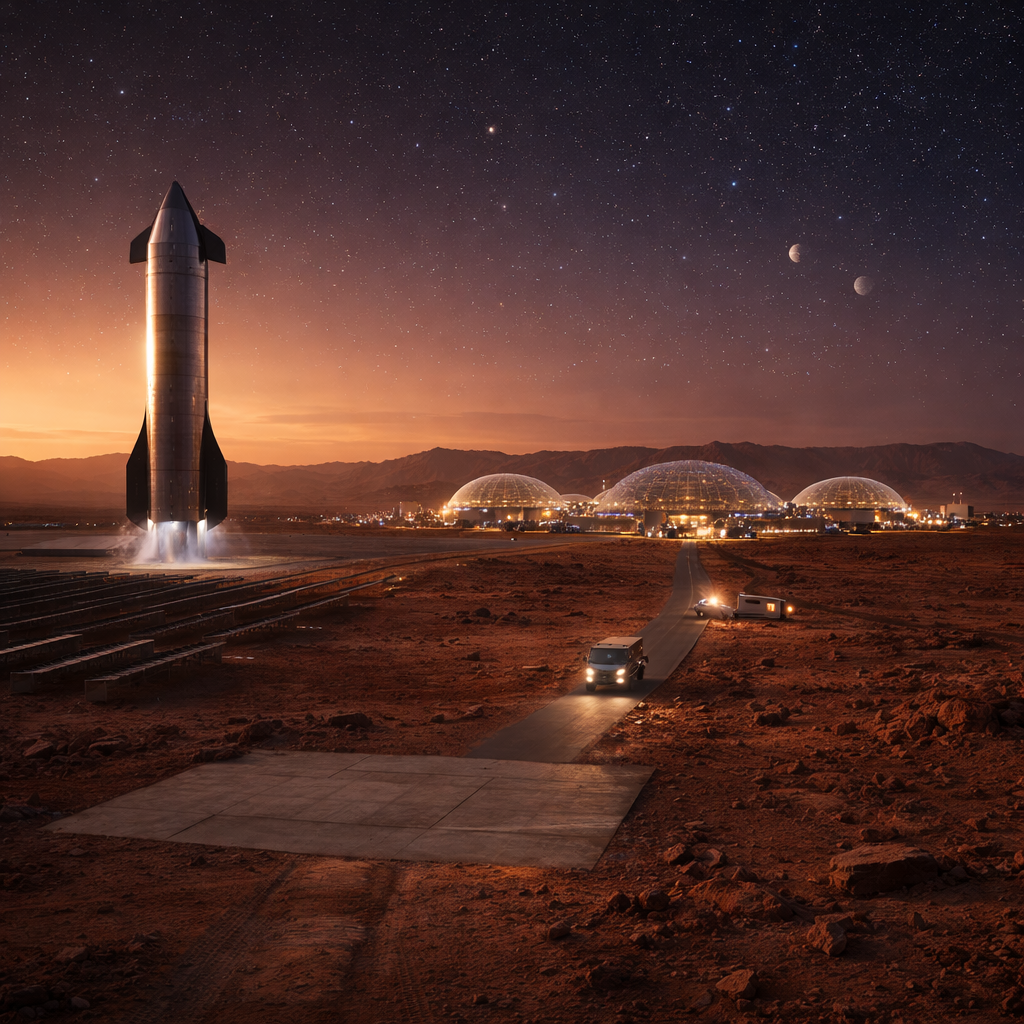
Autonomous compute infrastructure deployed by robots, powered by nuclear energy, connected via Starlink relay — operational before the first humans arrive.
It's not science fiction. It's infrastructure planning for the next decade. Every Mars colony, research station, and autonomous operation will need local compute, storage, and connectivity.
Earth-to-Mars signal delay ranges from 4 to 24 minutes. Real-time operations — robotics, life support, navigation — require local compute. You cannot run a Mars colony from Earth.
Earth faces existential risks — solar storms, asteroid impacts, climate collapse. Mars-based data centers provide true off-world backup for humanity's most critical data.
SpaceX plans robotic cargo missions before crewed flights. Data centers must be operational before colonists arrive — power, compute, and connectivity are day-one requirements.
Mars average temperature: -63°C. Data centers spend 40% of energy on cooling on Earth. On Mars, passive atmospheric cooling eliminates this entirely — zero energy cost.
SpaceX is building the interplanetary communication backbone. Starlink Mars relay enables 100+ Mbps data transfer with store-and-forward protocol for deep space latency.
The global data center market hits $344B by 2030. Off-world is the next frontier. First mover on Mars captures the entire interplanetary compute market — there are no competitors yet.
From site selection to operational handoff — we handle every layer of deploying compute infrastructure on Mars.
AI-driven analysis of Mars terrain data from NASA MRO and ESA Mars Express. We identify optimal locations based on subsurface ice access, solar exposure, geological stability, and Starlink relay line-of-sight.
Pre-fabricated modular data center units shipped via SpaceX Starship. Autonomous robots handle landing, transport, assembly, and commissioning — no human presence required for initial deployment.
Kilopower-class nuclear micro-reactors (10kW–1MW) as primary power, supplemented by solar arrays. Redundant power architecture ensures 99.9% uptime even during Mars dust storms lasting months.
Native integration with SpaceX's interplanetary Starlink network. Mars-orbit relay satellites provide continuous Earth-Mars data transfer. Local mesh networking connects surface facilities.
Our roadmap is anchored to real SpaceX launch windows and NASA mission milestones. Every phase has a concrete dependency and delivery target.
The convergence of reusable rockets, autonomous robotics, and interplanetary communication creates a window that didn't exist 5 years ago — and won't stay open forever.
Starship's full reusability drops Mars cargo cost from $1B+ to under $100M per mission. Infrastructure deployment becomes economically viable for the first time.
There are zero off-world data center providers. First operational facility on Mars captures the entire addressable market — every colony, every mission, every organization.
Physical infrastructure on Mars is the ultimate competitive moat. Once deployed, replication takes years and billions. First mover locks in decades of advantage.
Morgan Stanley projects the space economy exceeds $1.1T by 2040. Compute infrastructure is foundational to every space-based industry — mining, manufacturing, habitation.
NASA's Moon-to-Mars program, Artemis, and Mars Sample Return all require local compute. Government contracts provide anchor revenue before commercial demand scales.
Our AI-first architecture means facilities operate without human presence. This isn't a staffing problem — it's a software problem, and software scales.
Our architecture leverages existing space-proven systems and partnerships with the organizations building humanity's path to Mars.
Whether you're an investor, space agency, enterprise partner, or engineer — we want to hear from you. Request early access to our deployment roadmap and technical whitepaper.
Or reach us directly: ceo@apnok.com